
A homeowner's pipe just burst at 11pm. She grabs her phone, searches "emergency plumber South Jersey," and taps your listing. Your site takes seven seconds to load.
She's already called your competitor.
That's not a hypothetical. That's what happens every day to contractor websites that treat speed as an afterthought. Page speed has been a confirmed Google ranking factor since 2010 — and in 2024, Google raised the bar again with updated Core Web Vitals that measure exactly how fast and responsive your site feels to real visitors on real devices.
Here's what that means for your business, and what you can do about it.
Why Page Speed Is a Contractor Problem, Not Just a Tech Problem
Most trades run on urgency. A homeowner dealing with a leaking roof, a broken furnace in January, or a flooding basement is not browsing casually — they need someone now. When your site loads slowly on a mobile connection, you're not just creating a poor impression. You're sending that customer to the next result on the page.
Google knows this. That's why they measure and reward site speed directly through a set of performance signals called Core Web Vitals — and use those signals as a ranking factor in search results.
Faster sites rank higher. Higher rankings mean more calls. More calls mean more jobs.
The contractors winning in local search aren't just winning on reviews and keywords. They're winning on performance.
The Three Core Web Vitals That Matter in 2026
Google's Core Web Vitals are the official set of metrics used to measure real-world page experience. There are three signals you need to know:
LCP — Largest Contentful Paint
What it measures: How long it takes for the largest visible element on the page to load. Usually your hero image, headline, or above-the-fold photo.
Why it matters to contractors: Your hero section — the photo of your crew, your "Call Now" headline, your phone number — is the first thing a prospect needs to see. If it takes more than 2.5 seconds to appear, Google flags your page as slow.
| Score | Range |
| Good | Under 2.5 seconds |
| Needs improvement | 2.5–4.0 seconds |
| Poor | Over 4.0 seconds |
INP — Interaction to Next Paint
What it measures: How quickly your page responds when a visitor taps a button, fills out a form, or clicks a link.
Why it matters to contractors: When someone taps your "Request a Quote" button on mobile and nothing happens for a full second, they assume the page is broken and leave. INP replaced FID (First Input Delay) as an official Core Web Vital in March 2024 — it's a more complete measure of how your whole page responds to interaction, not just the first tap.
| Score | Range |
| Good | Under 200 milliseconds |
| Needs improvement | 200–500ms |
| Poor | Over 500ms |
CLS — Cumulative Layout Shift
What it measures: How much the page layout jumps around as it loads — images that pop in and push text down, buttons that shift position before a visitor can tap them.
Why it matters to contractors: A shifting layout is annoying on desktop. On mobile, it's a conversion killer. If a visitor tries to tap your phone number and an ad loads at the last second and moves it, that's a lost call. CLS penalizes exactly this kind of experience.
| Score | Range |
| Good | Under 0.1 |
| Needs improvement | 0.1–0.25 |
| Poor | Over 0.25 |
Quick note on what changed: If you've read articles about page speed before, you may have seen references to FID (First Input Delay). Google retired FID in March 2024 and replaced it with INP. Any speed audit or article still referencing FID is out of date. Make sure your developer or web partner is testing against the current three signals: LCP, INP, and CLS.
What a Slow Site Actually Costs a Contractor
Let's put numbers on this.
Google's own research found that a 1-second delay in mobile load time reduces conversions by up to 20%. For a contractor doing 10 qualified website leads per month, that's two lost jobs before the phone even rings.
Here's how that plays out by trade:
HVAC: Your busiest days are the hottest week in July and the first cold snap in November. That's when every homeowner is searching at the same time. A slow site on those peak days — when mobile traffic spikes and server loads are highest — means missed service calls at your highest-margin times of year.
Emergency plumbing: Speed isn't a nice-to-have — it's the whole game. A homeowner with water on the floor has 30 seconds of patience. If your site doesn't load fast on a mobile connection in that moment, you don't get a second chance.
Roofing: After a storm, leads come in a wave. Every contractor in your market gets a surge of search traffic at the same time. The fastest-loading site wins disproportionately in that window.
Landscaping: Seasonal demand is predictable, but competition is fierce. A slow site in March and April — when every homeowner in South Jersey is searching for a lawn care company — hands jobs directly to the faster, better-optimized site down the road.
How to Check Your Contractor Website's Speed Right Now
Three free tools give you a clear picture:
- Google PageSpeed Insights — Enter your URL and get a score out of 100 for both mobile and desktop, along with specific recommendations. Mobile score is the one that matters most for contractor sites.
- Pingdom Website Speed Test — Tests from multiple geographic locations and shows you a detailed waterfall of every file your page loads. Good for pinpointing exactly what's slowing you down.
- Google Search Console → Core Web Vitals report — If your site is connected to Search Console, this report shows real-world performance data from actual visitors. Look for pages flagged as "Poor" — those are hurting your rankings right now.
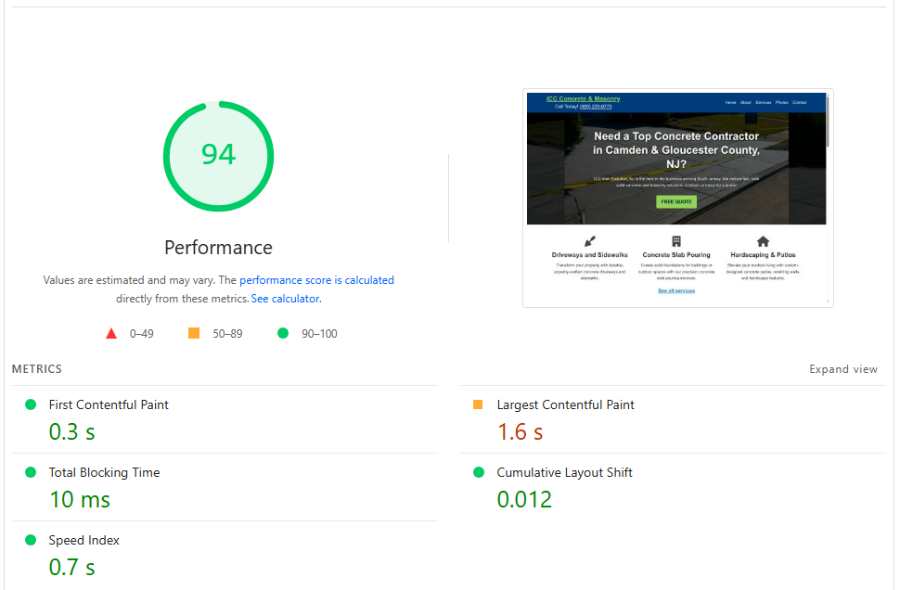
A score of 90+ on mobile is a realistic target for a well-built contractor site. If you're below 50, that's not just an SEO problem — it's a lead problem.
One more thing worth saying here: you don't need a perfect 100. Chasing a flawless PageSpeed score often means stripping out things that actually help you convert visitors — real job photos, embedded reviews, a click-to-call button that pops immediately. A site scoring 88 that loads in 2.1 seconds and has a clear phone number above the fold will out-earn a stripped-down 100-scoring site with nothing on it. The goal is fast enough to rank and built well enough to convert, not a trophy score.
What Slows Contractor Sites Down (And What Fixes It)
The most common culprits on contractor websites:
- Uncompressed images — A photo gallery of past jobs is great for conversion. Ten 4MB photos loading at once is great for sending visitors away. Images should be compressed, sized correctly for the display, and served in modern formats like WebP.
- Cheap shared hosting — The least expensive hosting plan puts your site on a server shared with thousands of other sites. Under traffic spikes — exactly when contractor sites see their highest demand — that shared environment throttles your load times.
- Bloated page builders and unused plugins — Many DIY website platforms and template builders load dozens of scripts and stylesheets even when they're not being used. Every unnecessary file is another request your visitor's phone has to wait on.
- No caching — Without proper caching, every visitor triggers a fresh database query to load your page. A caching layer serves pre-built versions of your pages instantly, cutting load times dramatically.
- No CDN (Content Delivery Network) — A CDN stores copies of your site on servers across the country. A homeowner in Cherry Hill loads your site from a New Jersey server. A homeowner in Philadelphia loads from one nearby too. Without a CDN, everyone loads from wherever your single server is located.
On WordPress sites I build, most of these issues are handled at the hosting level. Every site I build runs on SiteGround with their built-in optimizer plugin, which handles caching, image compression, CDN delivery, and a handful of other performance tasks automatically. It's not glamorous. It's just the right foundation.
That said, the plugin only works well when WordPress itself is set up correctly — a lean theme, no plugin bloat, clean code. Drop SiteGround Optimizer onto a poorly built WordPress site and you'll get modest improvement at best. The stack matters from the start.
Simple Wins Over Fancy Every Time for Contractor Sites
Here's something most web designers won't tell you: a clean, simple contractor website with real photos and visible reviews will outperform an elaborate, "professional" design almost every time.
Think about how a homeowner actually makes a decision. They're comparing three sites they found on Google. One has an outdated design with no photos. One has a flashy agency build with animations and a color-shifting hero video. The third has a photo of a real crew on a real job, a phone number at the top of the page, and five Google reviews visible without scrolling.
Who do they call? The third site. Every time.
Fancy design elements — parallax scrolling, custom animations, complex JavaScript interactions — all come with a performance cost. They slow your page down, add layout shift risk, and often get in the way of the one thing a homeowner needs to do: find your phone number and call it. Real photos of your work build trust faster than any visual effect. Real reviews beat polished copy. Simple navigation beats clever menus.
This doesn't mean your site should look like it was built in 2003. It means every design decision should answer one question: does this help someone contact me faster, or does it just look cool?
The "Nerd Stuff" Behind Every Fast Contractor Website
This is the part most people don't see — and the part that DIY website builders quietly skip.
Getting a WordPress site to load fast, rank in local search, and hold up over time isn't just about picking a clean template. There's a layer of technical work underneath every good contractor site that most people never think about until something breaks.
- Server configuration and hosting environment — managed hosting vs. shared, PHP version, database optimization
- WordPress core, theme, and plugin maintenance — outdated software is a security liability and a performance drag
- Image pipeline — compression, proper dimensions, WebP conversion, lazy loading
- Caching configuration — page cache, browser cache, object cache, all tuned correctly for WordPress
- Code-level cleanup — removing unused CSS, deferring non-critical JavaScript, eliminating render-blocking resources
- Schema markup — structured data that helps Google understand your business, services, and location
- Core Web Vitals monitoring — tracking LCP, INP, and CLS over time, not just at launch
None of this shows up in a template. A Squarespace or Wix site handles some of it automatically — and handles none of it particularly well. A WordPress site built without someone who understands this layer will score fine at launch and degrade over time.
"Most contractors find out their site has a technical problem when the phone stops ringing, not when someone sends them a report."
That's why ongoing maintenance isn't optional. It's how fast sites stay fast.
Why Few Web Designers Can Actually Do All of This
Here's an honest observation: the skills required to build a fast, high-ranking contractor website span multiple disciplines that most designers specialize in only one of.
Design is its own craft. Technical SEO is its own craft. Speed optimization requires engineering knowledge. Marketing requires understanding buyer psychology and how homeowners actually decide to call someone. Most agencies solve this by hiring separate people for each role — which adds cost, communication overhead, and gaps in accountability.
Most freelance designers are strong on visuals and weak on the technical side. Most SEO people aren't designers. Most marketers aren't engineers. And almost nobody doing this work has a background in computer engineering and fifteen years of hands-on experience building contractor sites specifically.
I'm not saying this to brag. I'm saying it because when you hire someone to build your website, you should know what questions to ask. Can they explain your Core Web Vitals score? Do they know what INP replaced and why? Can they show you their own hosting environment and explain why they chose it? Can they walk you through how they handle caching on a WordPress site?
If they can't answer those questions, your site speed — and your rankings — are probably an afterthought.
Speed Is a Symptom — Your Website Strategy Is the Diagnosis
Page speed matters, but it's part of a bigger picture. A contractor website that loads fast but has no clear call to action, no visible phone number, and no trust signals still won't generate calls.
The sites that consistently win in local search share three things:
- They load fast — 90+ PageSpeed score on mobile, clean Core Web Vitals
- They're built to convert — click-to-call phone numbers, clear service areas, real photos, visible reviews
- They're maintained — speed, security, and content are kept current month after month
That's not a one-time project. It's an ongoing standard. Which is why the most effective contractor websites aren't built once and forgotten — they're actively managed.
If you want to see what a fast, conversion-focused contractor website looks like in practice, browse the contractor website projects we've built — or read the complete guide to contractor websites in 2026 for a full breakdown of what separates winning sites from ones that just exist.
The Bottom Line
Your contractor website competes every day in local search results. Slow sites lose ground to faster ones — in rankings, in user experience, and in the calls that never come through.
The fix isn't complicated, but it does require doing it right: proper hosting, optimized images, clean code, and someone keeping an eye on performance over time. Not just at launch. Every month.
That's exactly what we handle as part of managed online marketing for contractors, and it's built into every custom contractor website we build from the ground up.
See what we can build for your contracting business — get your free demo in 30 seconds.